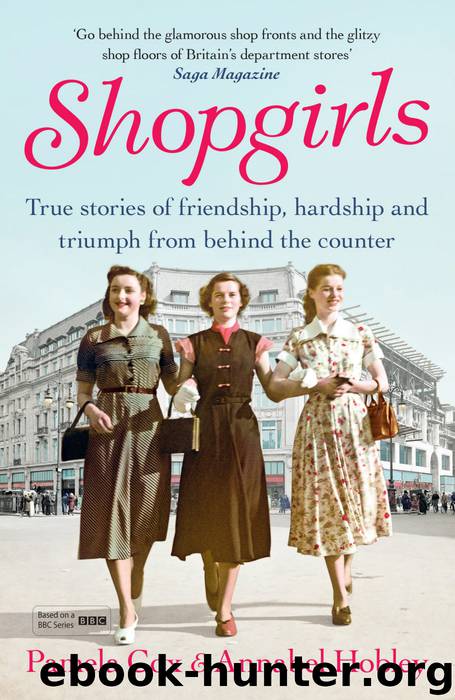
Shopgirls by Pamela Cox
Author:Pamela Cox
Language: eng
Format: epub
ISBN: 9781473505889
Publisher: Random House
‘Shopgirl As Strike Leader’: Hilda Canham and the strike committee during the John Lewis & Co. strike, May 1920.
CHAPTER 6
STRIKE!
After the armistice, with 900,000 British and Empire members of the armed forces dead and thousands more wounded, the weary veterans returning home faced not only the flu pandemic, but also very insecure job prospects. The staple industries such as cotton and coal mining that had earned Britain its nickname of the ‘workshop of the world’ were in decline, as Britain’s industrial and trading dominance was challenged by Germany and the USA. Now that the war was over, this decline was exposed and unemployment shot up.
Female war workers were made to relinquish their jobs for the returning men – munitions workers were sacked and the Restoration of Pre-War Practices Act in 1919 excluded women from most forms of industrial work. Women were expected to return to their former jobs, like domestic service, textile work and shopwork, and married women were expected to devote themselves to their domestic duties again. As the Ministry of Labour put it, ‘As soldiers return to their homes their wives are reverting to housewifery.’ Shopgirls who had taken the place of shopmen all across the retail trade were also required to step back down as the men returned. Some women missed their war work, its new horizons and camaraderie; others were glad to leave their wartime roles, seeing it as an extraordinary but circumscribed period in their lives.1
In spite of all these women having vacated their temporary positions, there were still simply not enough jobs to go around. Working-class wages crashed and many families suffered extreme hardship. Shopworkers were included in this. Stores throughout the country, from Costigan & Co. in Glasgow to John Lewis in London, had hardly raised their wages since the beginning of the war. At the point the union tested its increased strength, picking up the cudgels from where it had left off pre-war, targeting individual shops with demands for minimum wage scales, longer holidays and trade union recognition.
Despite its co-operative beginnings, one of the very worst offenders in terms of low pay was the Army & Navy Co-operative Society, known as ‘The Stores’, on Victoria Street in London. It was a historic establishment, set in its ways, its huge premises taking up a whole block. Before the war, Edwardian shopper Olivia waxed lyrical about its unchanging reliability. ‘The British Parliament is one institution, the Stores are another,’ she wrote in her Prejudiced Guide to London shopping. It was still a members-only store, where you had to present your membership number on entry, though it is clear that friends would pass their number on to each other. Olivia confessed that one particular membership number served hundreds of friends. ‘Who first gave it away, or to whom it really belonged, no one knew, but they all quoted it assiduously for spun silk underwear, and dreamed of bargains.’2 After eventually getting behind the War Office demands, the Stores had had a good war and profits were up.
Download
This site does not store any files on its server. We only index and link to content provided by other sites. Please contact the content providers to delete copyright contents if any and email us, we'll remove relevant links or contents immediately.
| Civilization & Culture | Expeditions & Discoveries |
| Jewish | Maritime History & Piracy |
| Religious | Slavery & Emancipation |
| Women in History |
Cecilia; Or, Memoirs of an Heiress — Volume 1 by Fanny Burney(32558)
Cecilia; Or, Memoirs of an Heiress — Volume 2 by Fanny Burney(31956)
Cecilia; Or, Memoirs of an Heiress — Volume 3 by Fanny Burney(31941)
The Secret History by Donna Tartt(19086)
Sapiens: A Brief History of Humankind by Yuval Noah Harari(14389)
Leonardo da Vinci by Walter Isaacson(13336)
The Radium Girls by Kate Moore(12028)
Sapiens by Yuval Noah Harari(5370)
How Democracies Die by Steven Levitsky & Daniel Ziblatt(5218)
The Wind in My Hair by Masih Alinejad(5095)
Homo Deus: A Brief History of Tomorrow by Yuval Noah Harari(4918)
Endurance: Shackleton's Incredible Voyage by Alfred Lansing(4781)
Man's Search for Meaning by Viktor Frankl(4605)
The Silk Roads by Peter Frankopan(4534)
Millionaire: The Philanderer, Gambler, and Duelist Who Invented Modern Finance by Janet Gleeson(4478)
The Rape of Nanking by Iris Chang(4211)
Joan of Arc by Mary Gordon(4109)
The Motorcycle Diaries by Ernesto Che Guevara(4098)
Stalin by Stephen Kotkin(3965)
